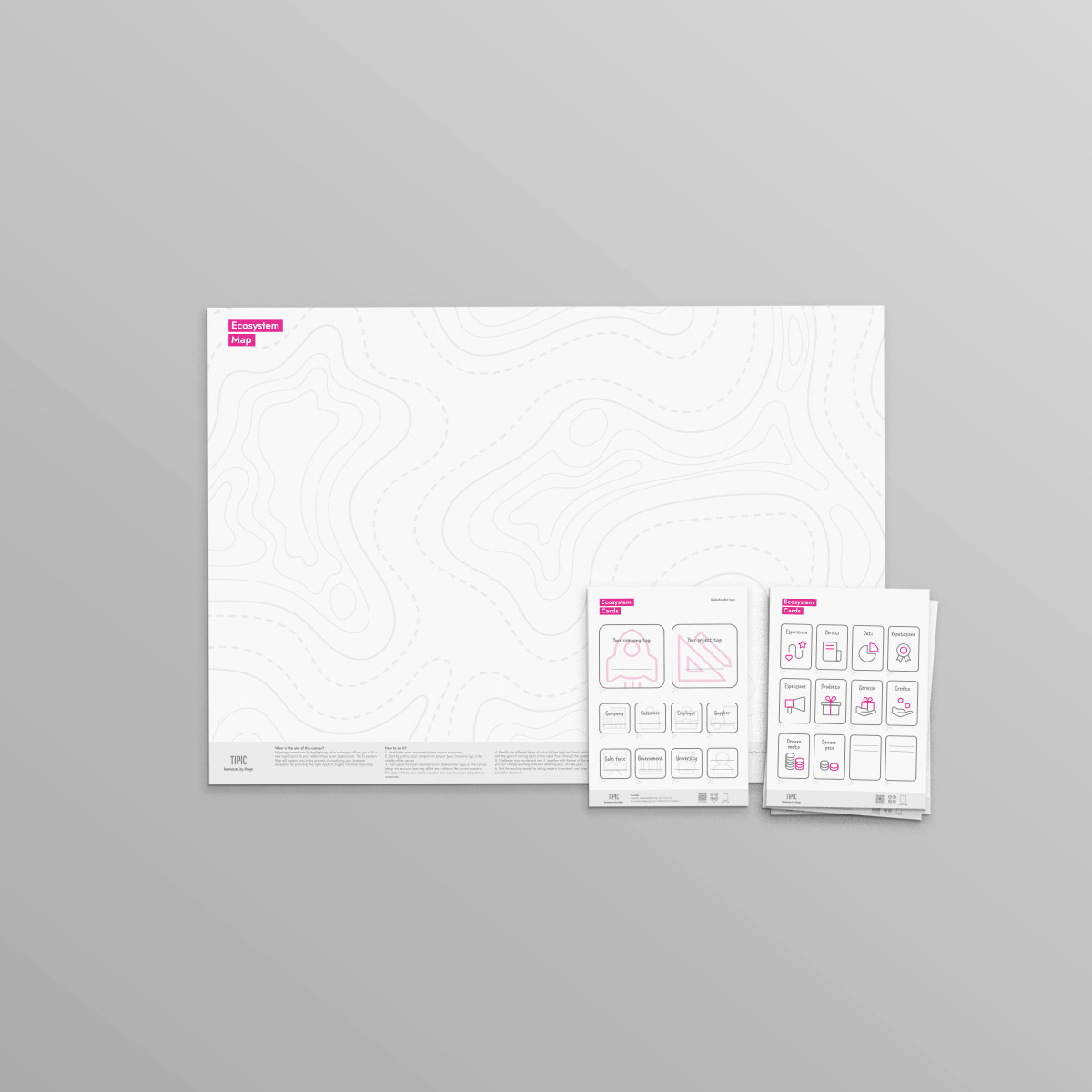
Designing Value Ecosystems: visualizing connections to generate synergies
Every business is supported by a complex web of relationships that fuels its success, but to evolve, you must know how to read it. The Ecosystem Map is the tool to move beyond "silo" thinking and visualize the entire landscape of actors involved: partners, suppliers, competitors, institutions, and communities. Use this canvas to trace the value flows (financial, informational, reputational) crossing your network.
Mapping these invisible connections is the first step in Futures Design: it allows you to identify strategic gaps and co-creation opportunities to innovate your business model and make it resilient to future changes.
From silos to ecosystem. Map value flows today to build the strategic alliances of tomorrow.
How to use the Ecosystem Map
Step 1: Define Key Players
Who is playing on your field? Make a complete inventory of all stakeholders. Don't stop at the obvious: include suppliers, distributors, regulators, competing startups, local communities, and even enabling technologies. The more exhaustive the list, the more powerful the analysis.
Step 2: Set the Center of Gravity
Place your organization (or the specific project you are analyzing) at the center of the canvas. You are the node through which you want to analyze the flows.
Step 3: Position and Group
Arrange the actors around the center. Use proximity strategically: place those with whom you have direct and frequent relations closer, and those who influence the ecosystem indirectly further away. Group them by category (e.g., Institutions, Market, Resources) to visualize where your network is concentrated.
Step 4: Trace Value Flows
This is the crucial phase. Connect actors to each other and to you using bidirectional arrows.
- What do you give? (Money, Products, Data, Exposure).
- What do you receive? (Trust, Technology, Services, Feedback). Remember: value is not just economic. Often, data or reputation flows are the true strategic assets of the future.
Step 5: Find "Black Holes" and Opportunities
Analyze the map critically. Are there actors giving a lot but receiving little (churn risk)? Are there broken or duplicated value flows? Identify inefficiencies and levers where you could create new synergies to better respond to upcoming market challenges.
Step 6: Stress-test with External Experts
Your view is partial. Submit the map to external stakeholders or industry experts. Ask them to find inconsistencies: "What is missing? Which relationship is overestimated?". Validating the model prevents you from building future strategies on wrong perceptions.
Frequently asked questions about the Ecosystem Map
What is an Ecosystem Map?
An Ecosystem Map is a canvas that visually represents the network of actors around an organization — partners, suppliers, competitors, institutions, communities — and the value flows connecting them: money, products, data, trust, reputation. It helps you read the system your business lives in.
What is an Ecosystem Map used for?
It helps you move beyond silo thinking: by mapping who gives what to whom, you surface imbalances (actors giving much and receiving little), broken flows, and strategic gaps. It is the basis for spotting co-creation opportunities, new alliances, and business models more resilient to future change.
How do you build an Ecosystem Map?
Take a complete inventory of actors, place your organization at the centre, arrange actors by proximity and category, then trace the two-way value flows (what you give, what you receive). Finally, analyse imbalances and opportunities, and stress-test the map with external experts.
What is the difference between an Ecosystem Map and a Stakeholder Map?
A Stakeholder Map classifies actors relative to a project, typically by interest and influence. An Ecosystem Map goes one step further: it also maps the relationships between actors and the value flows running through them, turning a list of stakeholders into a systemic reading of the business.
Where can I download a free Ecosystem Map template?
You can download TIPIC's Ecosystem Map canvas for free from this page, in English and Italian, with guiding questions to inventory actors, trace value flows, and spot the strategic opportunities in your ecosystem.