

Designing sustainable business models thanks to the systemic approach of design-driven innovation
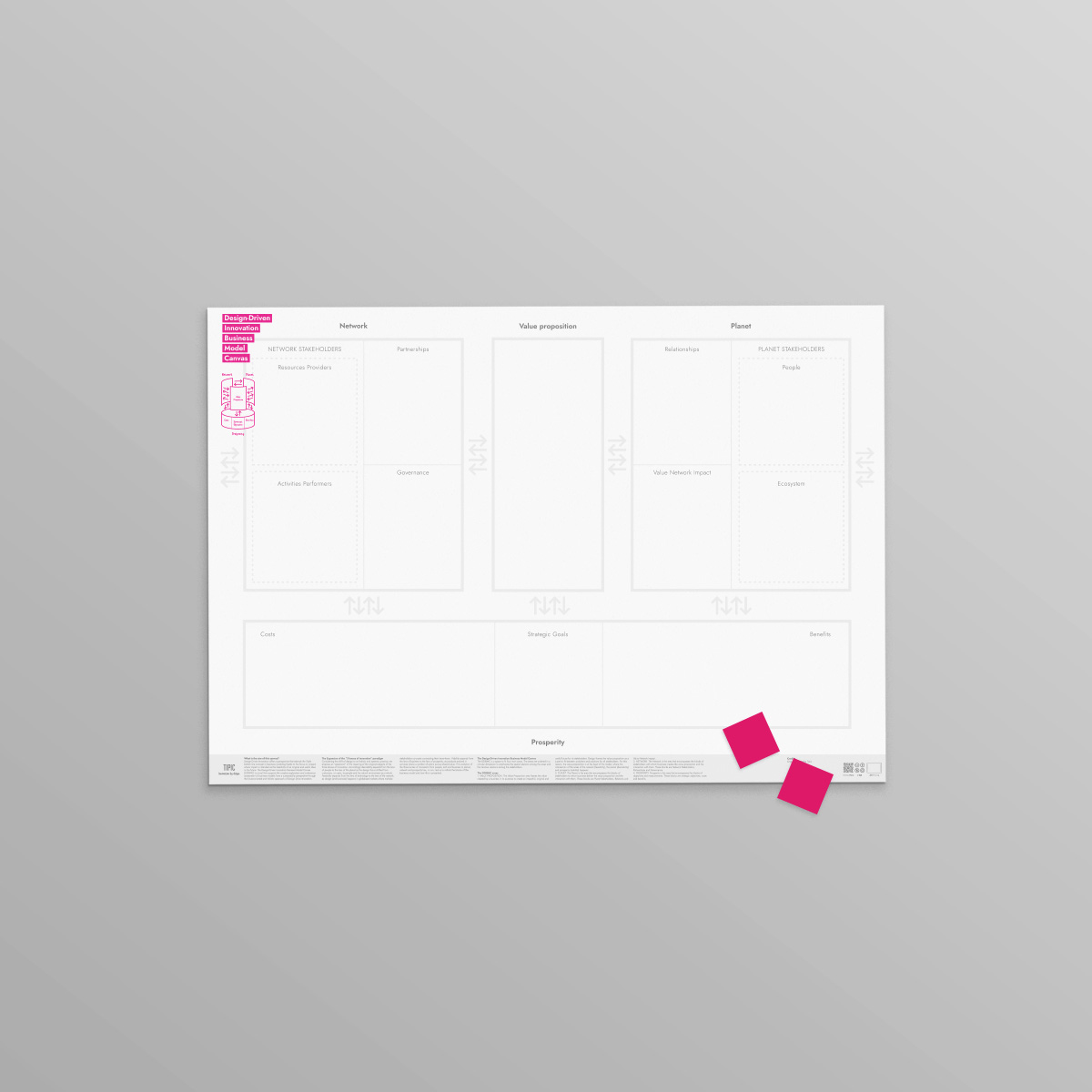
The Design-Driven Innovation Business Model Canvas is a tool that will support you in understanding and designing sustainable business models.
The Design-Driven Innovation Business Model Canvas shows how relationships create value. It shows the connections between stakeholders, whether they are people or the environment, society, or other organizations.
This tool shows how value is created in all exchanges and helps the ecosystem prosper. It is based on a study of the connection between business models and the 3 lenses of design innovation: Desirability (Planet), Feasibility (Network) and Viability (Prosperity).
Designing a business model with a systemic view means widening the viewpoint to all stakeholders and considering how one's network produces value from a prosperity perspective.
How to use the Design-Driven Innovation Business Model Canvas
A complex world involves stakeholders who may have multiple connections with us or our network and co-create value.
1. Value Proposition
Place the your Value Proposition at the center of your business model. The value proposition is what your organization and you as part of it provide to stakeholders to contribute to the prosperity of the system. Use the Impact Value Proposition Toolbox to design a value proposition from a systemic perspective.
2. Planet
Planet is the area of the Design-Driven Innovation Business Model Canvas that connect your value proposition with stakeholders. A stakeholder is anyone involved in the value proposition, including the environment in which the value proposition takes place.
3. Network
Network is the collaborative system of the business model where you activate relationships with providers of resources, knowledge, technology and process. These interconnections enable you to create value that would otherwise be unfeasible. This lens brings together stakeholders with whom you can build value in a B2B logic. They can be as resources or activity providers.
4. Prosperity
Prosperity is the concrete result of your efforts to improve the future. This area of the Design-Driven Innovation Business Model Canvas shows the benefits and costs of your value proposition. It is an open system where benefits and costs are dimensions of the relationship with all your stakeholders. Strategic goals are at its core. They are the cornerstone of the business objectives and the foundation of the value proposition.