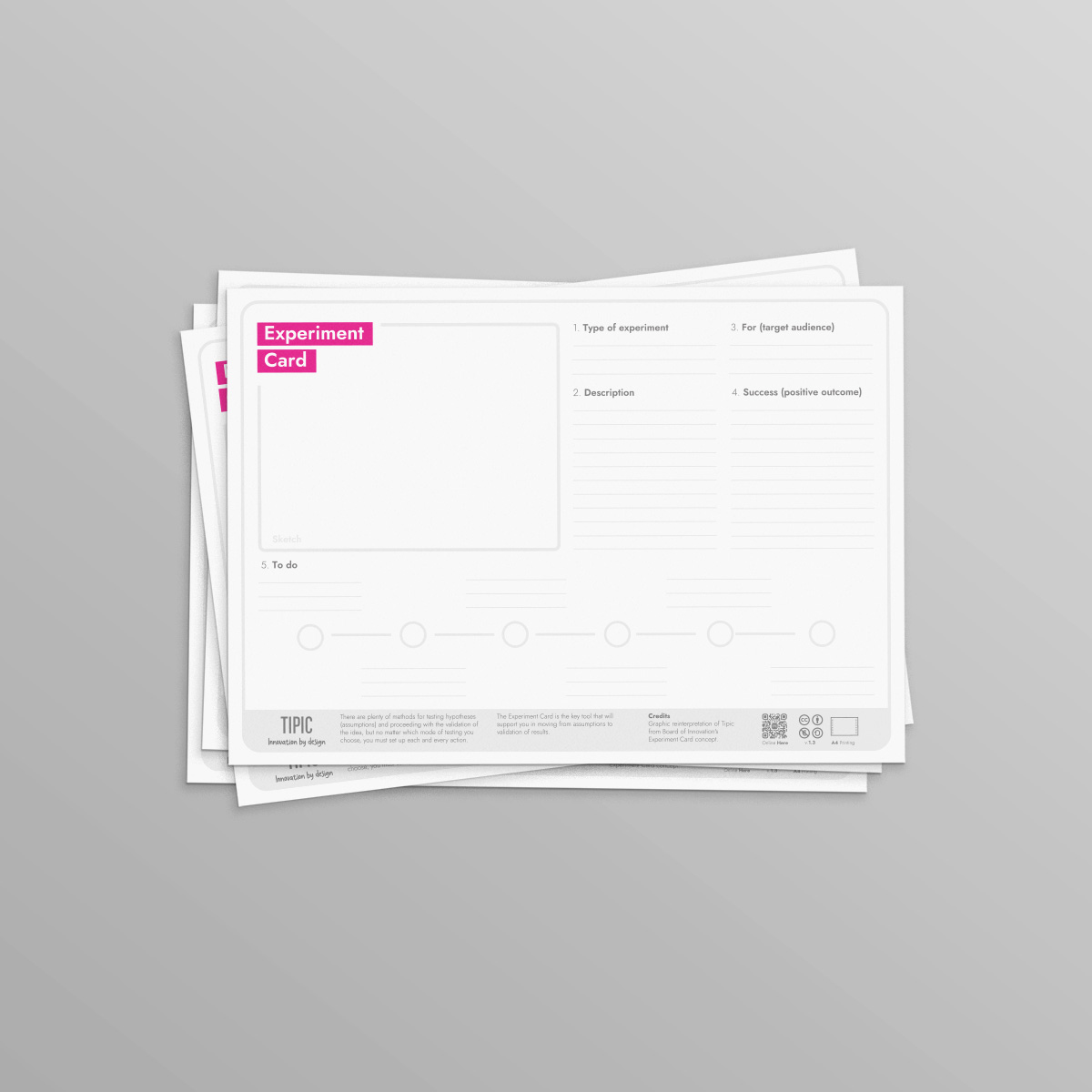


Moving from assumptions to validation of results
There are plenty of methods for testing hypotheses (assumptions) and proceeding with the validation of the idea, but no matter which mode of testing you choose, you must set up each and every action. The Experiment Card is the key tool that will support you in moving from assumptions to validation of results.
Define successful criteria and design a bias-free experiment
How to use the Experiment Card
1. First Step
Identify with the rest of the group which of the important and easy-to-test assumptions you want to validate or confute.
2. Second Step
Each team member, individually, completes the Experiment Card choosing the type of test for the identified hypothesis describing each action.
3. Third Step
Distribute the completed sheets, read them and write your feedback on sticky notes.
4. Forth Step
Discuss the experiments as a group to make sure everyone has the actions described (clear hypothesis, success criteria, etc.).
5. Fifth Step
Conclude by reviewing next steps, roles and responsibilities, and do not forget to find a moment, later, to analyze the results of the experiments.