

Questo testo è responsive

Scenario Planning Toolbox

Scenario Planning Toolbox

Scenario Planning Toolbox

Navigating uncertainty with Scenario Planning: from risk to actionable strategy

The future is not a straight line; it is a fan of possibilities. The Scenario Planning Toolbox is the operating system to stop "guessing" the future and start preparing for it. Forget predictions based on the past: this framework guides you in identifying the Critical Uncertainties weighing on your business and crossing them to generate plausible alternative worlds. 

It's not about writing science fiction, but creating a "strategic gym" where you can test the solidity of your decisions today against tomorrow's shocks. Turn the unpredictable into a planned advantage.

Don't bet on a single future. Design resilient strategies capable of thriving in any scenario.

How to use the Scenario Planning Toolbox

Step 1: Define the Focal Issue

You can't "do scenarios" on everything. Clearly define the perimeter: what is the strategic decision, product, or market you want to query the future about? Establish a precise time horizon (e.g., 5, 10, or 20 years).

Step 2: Map and filter forces (Relevance-Uncertainty)

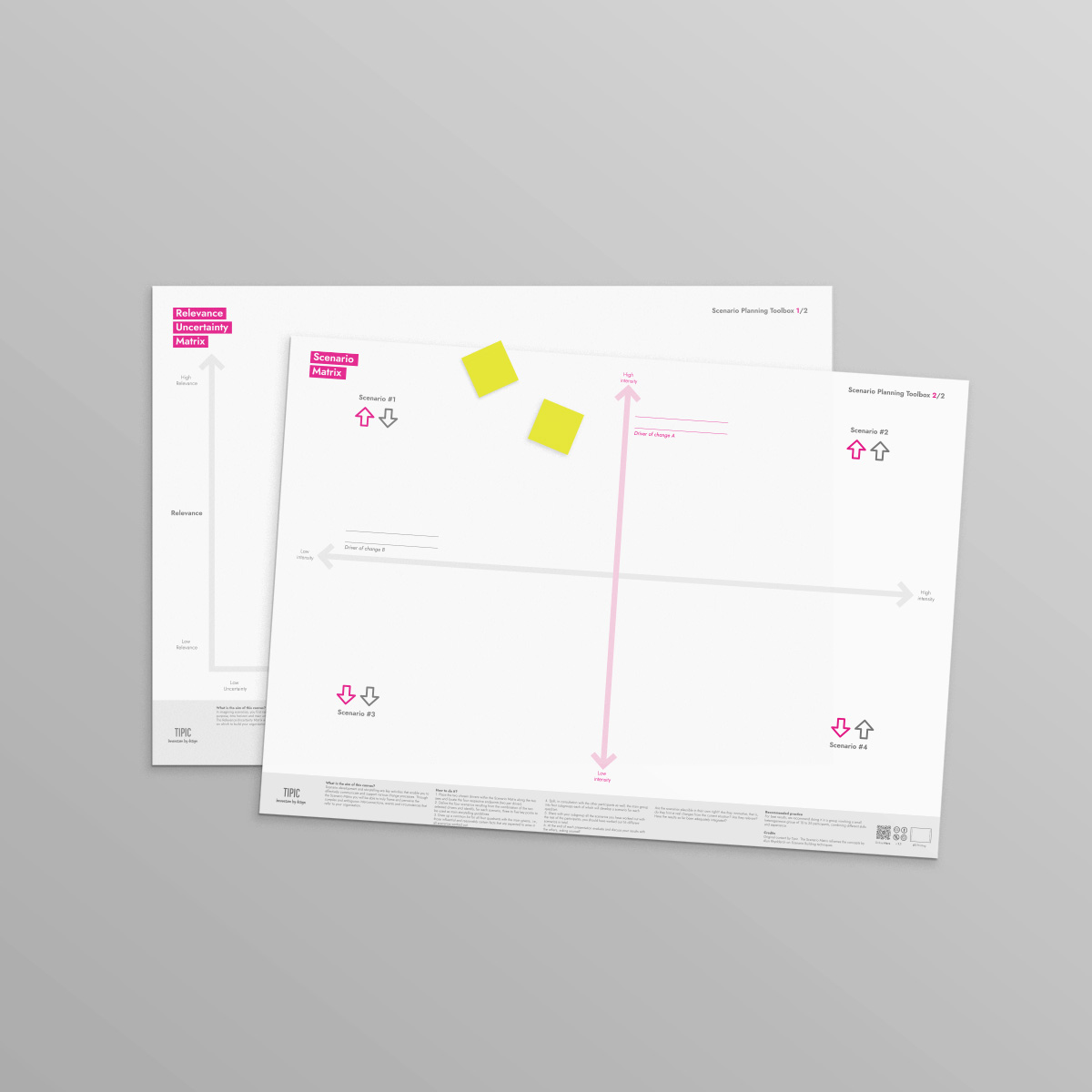
Collect trends and signals of change (social, technological, economic). Now, use the Relevance-Uncertainty Matrix to filter them: separate what is certain (Trends) from what is fundamental yet unpredictable (Critical Uncertainties). These are the cornerstones of your scenarios.

Step 3: Build the Matrix (2x2 Scenario Matrix)

This is the core of the method. Take the two most impactful and independent Critical Uncertainties and use them as Cartesian axes (e.g., "High/Low Regulation" vs "Slow/Fast Tech Adoption"). Crossing these axes generates 4 distinct quadrants: four logical, extreme, and divergent futures.

Step 4: Bring worlds to life (Storytelling)

A quadrant is just a chart until you tell it. Develop an immersive narrative for each scenario: who wins and who loses in this world? How do customers live? Give each scenario an evocative title (e.g., "Asphalt Jungle" or "Digital Renaissance") to make it memorable and communicable to the team.

Step 5: Strategic Stress-test (Wind-tunneling)

Now return to the present. "Immerse" your current strategy or product into each of the 4 scenarios. Does it hold up in all worlds or just one? Use these insights to modify your plan, creating a robust "Future-proof" strategy that works regardless of what happens.

Is this tool right for you?
Tell us about yourself and try it!

    My name isand I am currently working at. Please send me a copy of your Scenario Planning Toolbox at my email. Thank-you!

    Back to Tools

    1200 1200 Tipic
    Privacy Preferences

    When you visit our website, it may store information through your browser from specific services, usually in the form of cookies. Here you can change your Privacy preferences. It is worth noting that blocking some types of cookies may impact your experience on our website and the services we are able to offer.

     
    You can find more information here:
    Our website uses cookies, mainly from 3rd party services. Define your Privacy Preferences and/or agree to our use of cookies.